

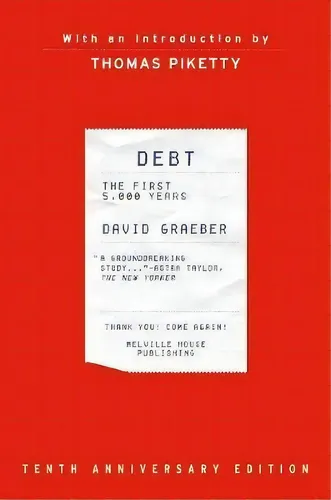
Melville House Publishing • Published 2011
Debt: The First 5,000 Years
Una historia alternativa de la economía
Synopsis
Economics textbooks often tell a familiar story: first there was barter, then money appeared, and finally credit and debt developed. David Graeber reverses that chronology. In Debt: The First 5,000 Years, he argues, drawing on anthropological and historical evidence, that obligations, accounts, and forms of credit existed long before coined money, and that economic relations have never been separate from the language of morality, religion, and political authority.
The starting point is not exclusively monetary. What does it mean to owe something to another person? When does an obligation express reciprocity, and when does it become a relation of subjection? Graeber explores how promises, gifts, tributes, compensations, taxes, and loans have been embedded in different institutions over millennia. His inquiry moves through Mesopotamia, ancient and medieval societies, cycles of imperial expansion, and the transformations of modern capitalism, without assuming that a single model explains every form of exchange.
One of the distinctions structuring the book separates relations of care and cooperation, exchanges between equivalents, and socially established hierarchies. Debt takes on very different meanings depending on its setting: it may name a mutual obligation, facilitate a transaction, or serve to justify violence. Debt slavery, state taxation, the financing of wars, and forms of punishment show that economies are also built through decisions about who may demand what, from whom, and under which conditions.
The book challenges the notion that the market is naturally a realm isolated from politics. It also investigates the proximity between financial vocabularies and notions of guilt, redemption, or forgiveness. Rather than describe debt as a self-contained magnitude, Graeber returns it to the conflicts that determine what a society considers just, legitimate, or nonnegotiable.
His broad historical ambition has sparked debate and objections among specialists; some generalizations and long-range reconstructions remain contested. That controversy does not diminish the force of his central question: why is the duty to repay so often presented as absolute, even where other human obligations are subordinated to it? Published in 2011, Debt argues that understanding money requires studying the history of power and, above all, the social conditions that turn a promise into an enforceable debt.
Book details
- Author
- David Graeber
- ISBN
- 9781933633862
- Year
- 2011
- Publisher
- Melville House Publishing
- Country of publication
- Estados Unidos
- Format
- Tapa dura; 534 páginas
- Edition
- Primera edición inglesa, mayo de 2011
Keep reading
View all ↗