W. H. Freeman and Company • Published 1994
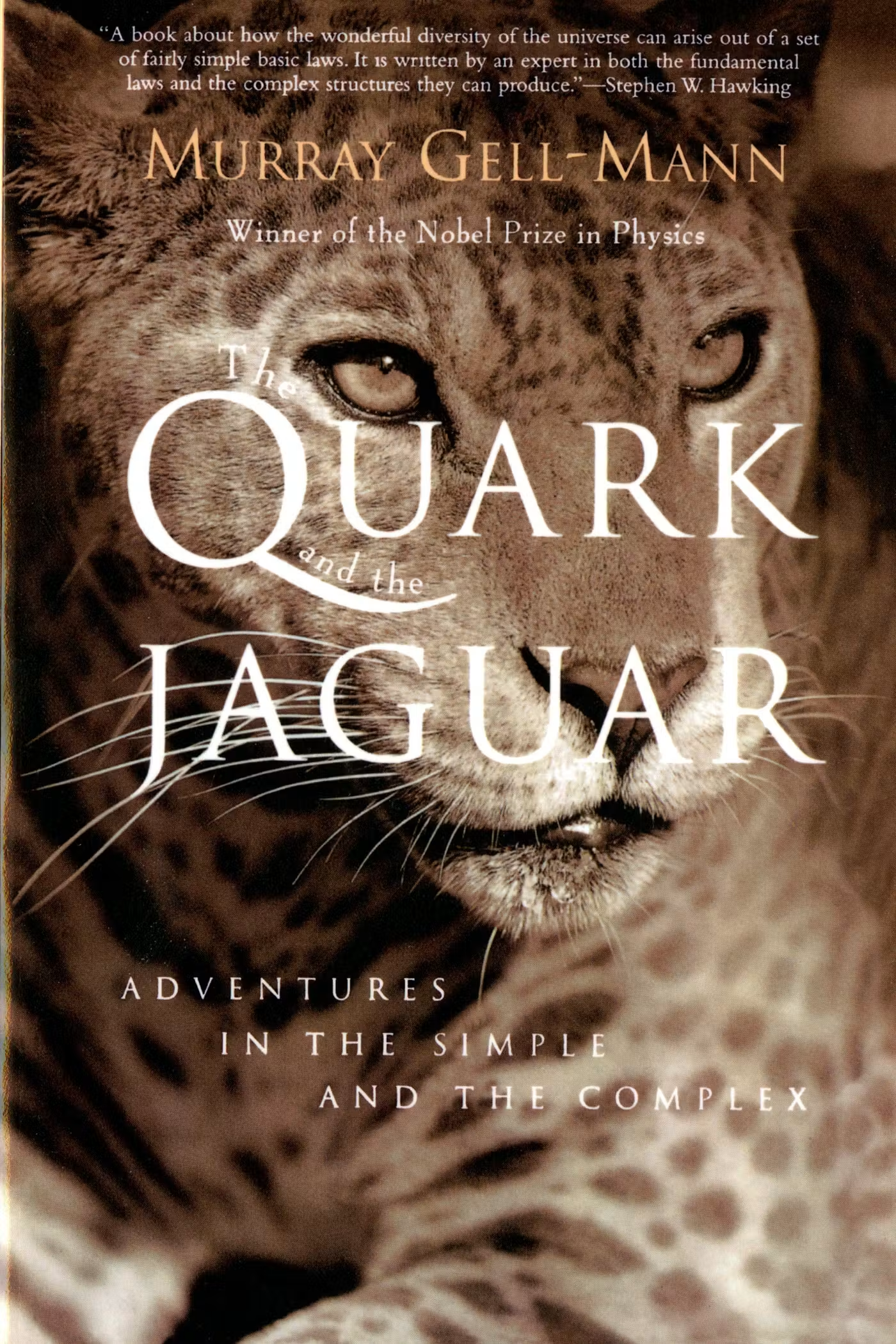
The Quark and the Jaguar
Adventures in the Simple and the Complex
Synopsis
How can a universe governed by a relatively small number of physical principles produce jaguars, languages, cities, cultures, and ecological systems of bewildering variety? Murray Gell-Mann takes this question as the organizing thread of The Quark and the Jaguar. The distance between the quark, emblematic of the elementary components of matter, and the jaguar, an organism whose behavior depends on a singular biological and environmental history, structures a reflection on the relationship between the simple and the complex.
The author, awarded the Nobel Prize in Physics for his contributions to the classification of elementary particles, does not portray complexity as a mere residue of our ignorance. He examines how, against a background of physical regularities, structures emerge that store information, adapt, learn, and participate in evolutionary processes. Information, chance, regularity, selection, and historical processes help explain why knowing the fundamental laws is not the same as being able to reconstruct immediately every feature of emergent phenomena.
The narrative moves between particle physics and quantum mechanics and examples of childhood learning, bacterial resistance, scientific inquiry, creativity, natural history, and ecosystems. Its questions cannot be confined to a single discipline. What do a community that corrects its theories and a biological population subject to selection pressures have in common? How can complex adaptive systems be described without reducing them to machines with predictable behavior? The book's intellectual horizon is linked to the interdisciplinary work Gell-Mann promoted at the Santa Fe Institute, where researchers from different fields investigated forms of organization capable of producing historical novelty.
The work also has an ethical and environmental dimension. Thinking about complexity means recognizing the fragility of biological and cultural systems whose richness depends on relationships that cannot simply be replaced by mechanical substitutes. Scientific knowledge does not necessarily license unrestricted control over these systems; on the contrary, it can make their limits and vulnerabilities visible.
Published in 1994, The Quark and the Jaguar combines science writing, epistemological reflection, and an invitation to reconsider the very meaning of explanation. Its most fertile claim is not that every complex phenomenon can easily be deduced from simple laws, but that uncovering the connections between these levels requires concepts, scales, and methods that no single science possesses exclusively.
Purchase link coming soon
Book details
- Author
- Murray Gell-Mann
- ISBN
- 9780716725817
- Year
- 1994
- Publisher
- W. H. Freeman and Company
- Country of publication
- Estados Unidos
- Format
- Tapa dura; 392 páginas
- Edition
- Primera edición inglesa, 1994
Keep reading
View all ↗