Oxford University Press • Published 1989
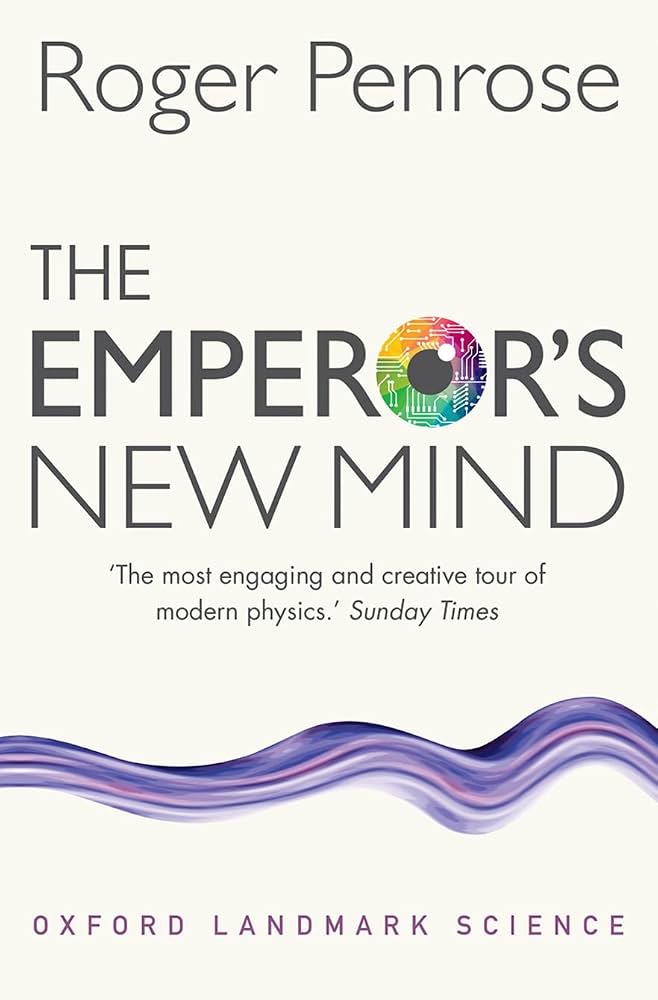
The Emperor's New Mind
Concerning Computers, Minds, and the Laws of Physics
Synopsis
Is human thought reducible to an algorithm? Roger Penrose places this question at the heart of The Emperor's New Mind and turns it into a demanding journey through some of the fundamental ideas of twentieth-century mathematics and physics. Against the expectation that a sufficiently sophisticated program could fully reproduce intelligence, the physicist and mathematician argues that understanding is not necessarily equivalent to executing computational rules. The book does not merely discuss the performance of machines: it examines what it means to think, to prove, to recognize a truth, or to have conscious experience.
The argument begins in the domain of computability. Turing machines, algorithmic procedures, and the limits of formal systems lead to Gödel's incompleteness theorems. Penrose interprets these results as a challenge to the image of the mind understood exclusively as mechanical symbol processing. That interpretation, however, has prompted philosophical and technical objections: the existence of undecidable propositions in certain systems does not, by itself, demonstrate that a person escapes every computational description. The essay's intellectual force lies precisely in compelling us to examine carefully what we claim when we attribute understanding to a system.
The investigation then moves toward the structure of the physical universe. Classical mechanics, relativity, quantum theory, cosmology, entropy, and the search for a theory of quantum gravity are connected to the problem of the mind. Penrose conjectures that an adequate scientific explanation of consciousness might require as-yet-unknown physical laws and perhaps noncomputable processes. He does not present as an established fact the idea that the brain operates quantum mechanically in a way that resolves the question; rather, he proposes a speculative research program whose foundations remain contested.
Published in 1989, when artificial intelligence and cognitive science were exploring new models of the mind, the book retains an unsettling relevance. Its value does not depend on accepting all its conclusions. It lies in forcing an encounter between the limits of mathematical proof, the foundations of physics, and the enigma of subjective experience. Before declaring the relation between mind and machine settled, Penrose invites us to ask whether we know enough about the nature of either.
Purchase link coming soon
Book details
- Author
- Roger Penrose
- ISBN
- 9780198519737
- Year
- 1989
- Publisher
- Oxford University Press
- Country of publication
- Reino Unido
- Format
- Tapa dura; xiii + 466 páginas
- Edition
- Primera edición inglesa, 1989
Keep reading
View all ↗