Princeton University Press • Published 2015
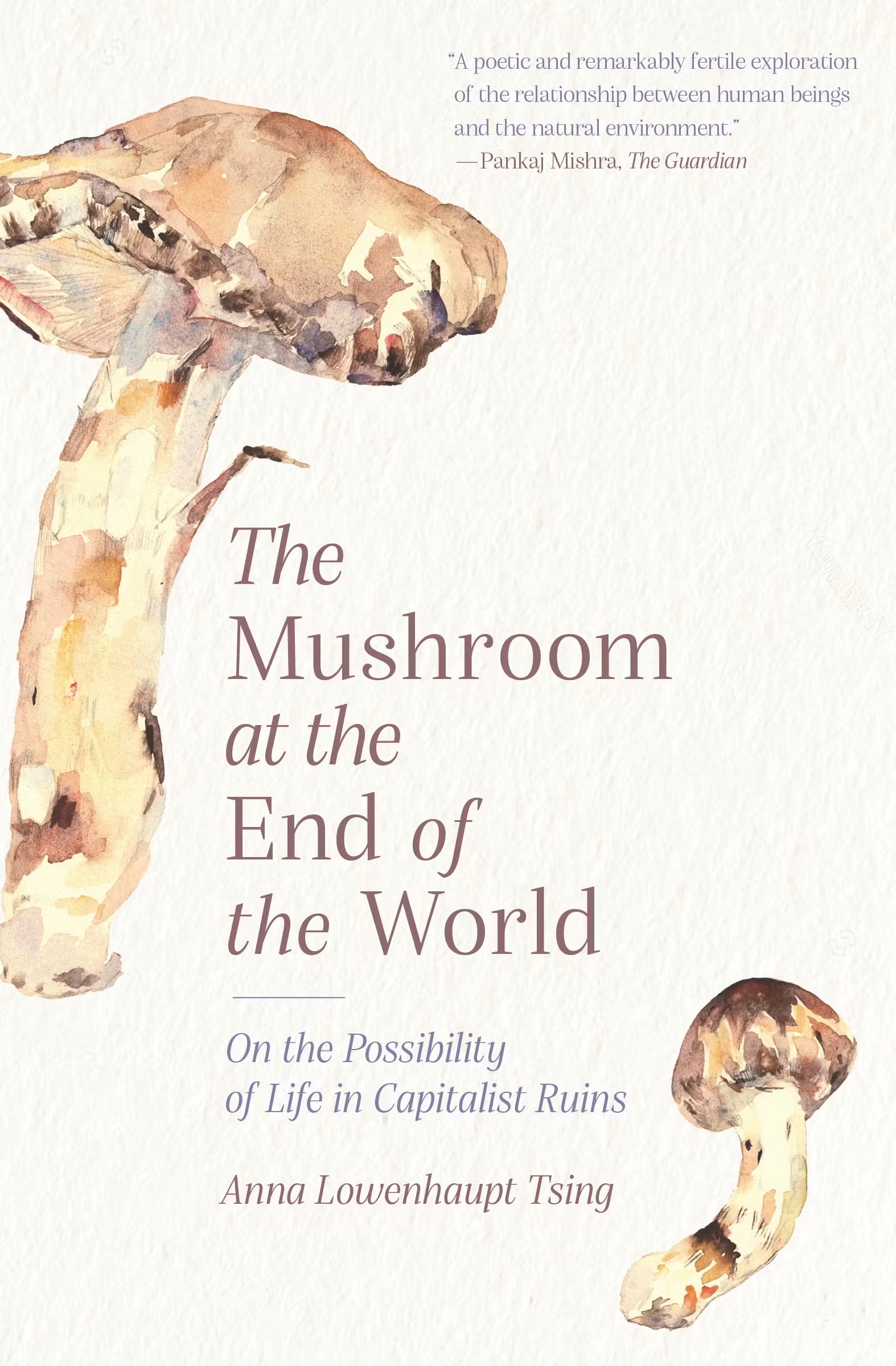
The Mushroom at the End of the World
On the Possibility of Life in Capitalist Ruins
Synopsis
What can a mushroom teach us about the world economy and the possibilities of living after devastation? Anna Lowenhaupt Tsing takes matsutake—a mushroom prized in Japan and gathered in forests altered by human activity—as the entry point into an inquiry connecting anthropology, ecology, history, and international trade. The Mushroom at the End of the World argues that understanding our time requires more than tracing the routes of capital: we must also attend to unstable encounters among species, people, and landscapes that no plan can fully control.
Tsing reconstructs an unusual commercial chain. Matsutake grows in territories affected by logging, displacement, and conflict; it is sought by foragers with diverse migrant histories and acquires new meanings as it moves through specialized markets before becoming a highly valued gift in Japan. At each point along this route, criteria of price, social ties, and the very idea of work change. The global commodity cannot be separated from local worlds that resist reduction to a universal economic formula.
Tsing uses the concept of salvage accumulation to examine how capitalism draws value from activities and relationships it does not entirely organize. Unlike a standardized factory, foraging depends on practical knowledge, forest cycles, and unpredictable encounters. The precarity of these processes is not a temporary exception: it forms part of the material conditions of many contemporary lives. The book thus invites us to observe forms of survival without romanticizing the insecurity endured by those who sustain them.
The inquiry also shifts attention toward collaboration among species. Mushrooms and trees form ecological associations that persist in profoundly altered landscapes. Tsing does not present these relationships as a restored natural harmony, but as contingent assemblages marked by disturbances, inequalities, and partial opportunities. Against narratives that admit only linear progress or total collapse, she proposes learning to recognize multiple temporalities, dependencies, and open futures.
Published in 2015, The Mushroom at the End of the World is an original intervention in the anthropology of capitalism and the environmental humanities. Its question promises no easy salvation: what ways of knowing, living together, and assuming responsibility remain possible when we can no longer imagine life unfolding against a stable, pristine backdrop available for exploitation?
Book details
- Author
- Anna Lowenhaupt Tsing
- ISBN
- 9780691162751
- Year
- 2015
- Publisher
- Princeton University Press
- Country of publication
- Estados Unidos
- Format
- Tapa dura; 352 páginas
- Edition
- Primera edición inglesa
Keep reading
View all ↗