

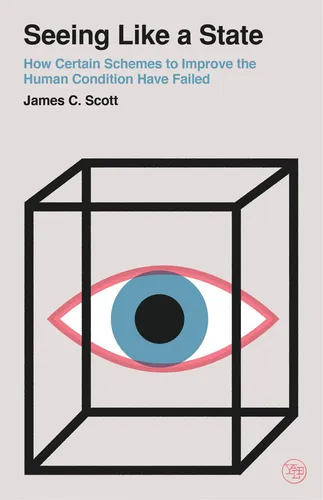
Yale University Press • Published 1998
Seeing Like a State
How Certain Schemes to Improve the Human Condition Have Failed
Synopsis
What does a state see when it looks at a society? James C. Scott offers an unsettling answer: it sees what its instruments can record, organize, compare, and administer. Seeing Like a State examines the distance between the complexity of human lives and the simplifications that make them governable. Stable surnames, land registries, censuses, maps, uniform measures, and productive classifications render legible a reality that was previously opaque to central power. These are not neutral operations: in turning a multiplicity of practices into manageable data, they can alter the very social relations they claim to describe.
Scott does not argue that every form of state knowledge is useless or that measurement is inherently an act of violence. His concern lies with circumstances in which administrative legibility becomes a claim to redesign collective life in its entirety. The danger grows when this simplifying capacity combines with an ideal of scientific modernization that places unlimited faith in planning, a political power capable of imposing it, and a civil society too weakened to contest its consequences.
The book reconstructs projects of enormous ambition: scientific forestry, the geometric organization of cities, agricultural collectivization, the transformation of villages, and the restructuring of peasant practices. A recurring difficulty emerges: experts' generalizable knowledge tends to overlook local adaptations needed to respond to soils, climates, landscapes, conflicts, and shifting needs. A solution that is elegant on paper can destroy the practical relationships that sustain a community.
Against this abstraction, Scott recovers the idea of mêtis: situated knowledge, acquired through experience, trial, and correction, which can seldom be fully captured by a form or a technical model. This defense of practical intelligence is not a romantic rejection of science. It is a demand for epistemological modesty in the face of social and ecological systems whose components interact in ways that are hard to anticipate.
Published in 1998, Seeing Like a State remains a reference point for thinking about bureaucracy, development, public policy, and territorial planning. Its question reaches beyond the history of the great failures of the twentieth century: how can we build institutions capable of intervening without confusing their representation of society with society itself?
Book details
- Author
- James C. Scott
- ISBN
- 9780300070163
- Year
- 1998
- Publisher
- Yale University Press
- Country of publication
- Estados Unidos
- Format
- Tapa dura; 445 páginas de texto
- Edition
- Primera edición inglesa
Keep reading
View all ↗