Houghton Mifflin Harcourt • Published 2017
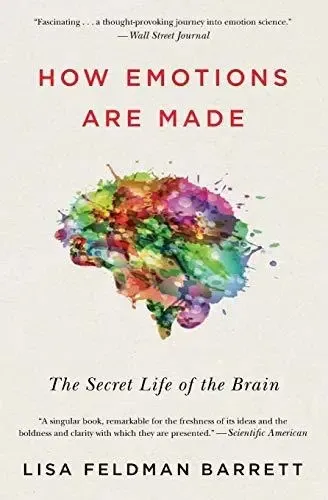
How Emotions Are Made
The Secret Life of the Brain
Synopsis
Why do we experience fear, anger, or joy as events that simply happen to us if the brain does not seem to contain a single, unchanging biological signature for each emotion? In How Emotions Are Made, Lisa Feldman Barrett challenges the classical view that emotions are universal programs, built into specific circuits and recognizable through stereotyped facial expressions. In its place, she develops the theory of constructed emotion: emotional experience arises in particular situations through the coordinated action of bodily processes, brain predictions, learned concepts, and context.
Here the brain appears less like a receiver of stimuli that trigger preset responses than like an organ that anticipates, regulates, and interprets. Drawing on past experience, it predicts needs and organizes perception to maintain the organism's balance. Interoception—the perception and regulation of signals coming from within one's own body—plays a fundamental role, but these sensations do not arrive with unmistakable labels such as sadness, shame, or rage. Emotional categorization helps construct their meaning.
This perspective transforms the role of language and culture. The concepts available within a community influence the distinctions people use to interpret their bodily states and the situations they encounter. Barrett therefore questions excessive confidence in identifying other people's emotions from isolated faces and raises difficult questions for medicine, education, law, and automated systems of affect recognition.
The book also has a philosophical consequence: it challenges a rigid boundary between the biological and the social without denying that emotions are real and physically experienced. Barrett's theory has prompted significant debate within affective science and coexists with alternative perspectives that maintain varying degrees of emotional universality. Its value lies in forcing us to reconsider a convenient assumption: that we know our emotions because they are fixed pieces of nature. Emotional experience emerges instead as a cerebral, bodily, historical, and relational event whose explanation calls for multiple scales of analysis.
Purchase link coming soon
Book details
- Author
- Lisa Feldman Barrett
- ISBN
- 9780544133310
- Year
- 2017
- Publisher
- Houghton Mifflin Harcourt
- Country of publication
- Estados Unidos
- Format
- Tapa dura, 448 páginas
- Edition
- Primera edición inglesa, marzo de 2017
Keep reading
View all ↗