

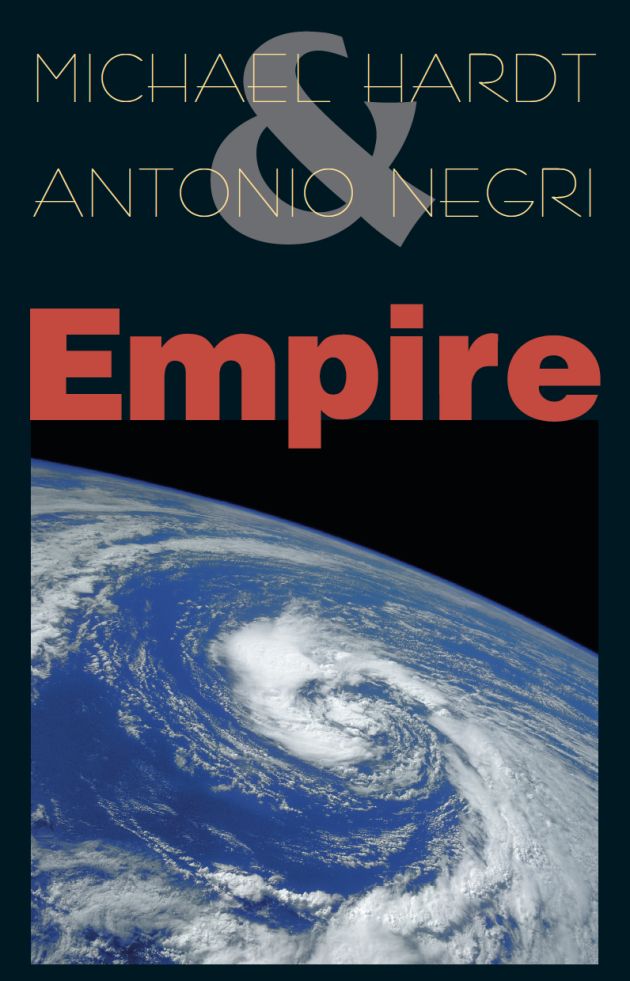
Harvard University Press • Published 2001
Empire
Synopsis
What name can we give to power when sovereignty no longer fully coincides with national borders? In Empire, published in 2000, Michael Hardt and Antonio Negri argue that globalization must be understood not simply as economic expansion but as the emergence of an unprecedented form of political order. Classical imperialism, organized around territorial powers and metropolitan centers, would give way to a worldwide sovereignty that the authors call Empire.
This Empire does not simply mean the United States, nor a single world government. It is an unstable arrangement of states, supranational organizations, corporations, legal frameworks, military apparatuses, and networks of communication and production. Its power operates through networks, claims to establish an order without a clearly defined outside, and simultaneously reorganizes the conditions of political authority and everyday life. Inherited concepts of nation, people, territory, and sovereignty become insufficient to grasp this transformation.
The argument brings together Marxist and post-Marxist traditions with readings of Spinoza, Foucault, and Deleuze to explore biopower, biopolitical production, immaterial labor, mobility, and new forms of exploitation and resistance. In place of the unified political subject of modernity appears the multitude: a plurality of singularities capable of cooperating and producing alternatives within the very network of relations that subjugates them.
Empire is at once a comprehensive interpretation of global capitalism and a normative intervention into the possibility of a different democracy. Its diagnoses of the changing role of states and the configuration of global power sparked intense debate, while subsequent tensions among globalization, nationalism, and geopolitical rivalries invite a critical rereading. The book’s force lies in having changed the scale of the question of sovereignty: it is no longer enough to identify who rules; we must understand how a multiplicity of powers produces the world in which rule is exercised.
Book details
- Author
- Antonio Negri, Michael Hardt
- ISBN
- 9780674006713
- Year
- 2001
- Publisher
- Harvard University Press
- Country of publication
- Estados Unidos
- Format
- Paperback, 496 páginas
- Edition
- Primera edición inglesa en tapa blanda, 2001
Keep reading
View all ↗